

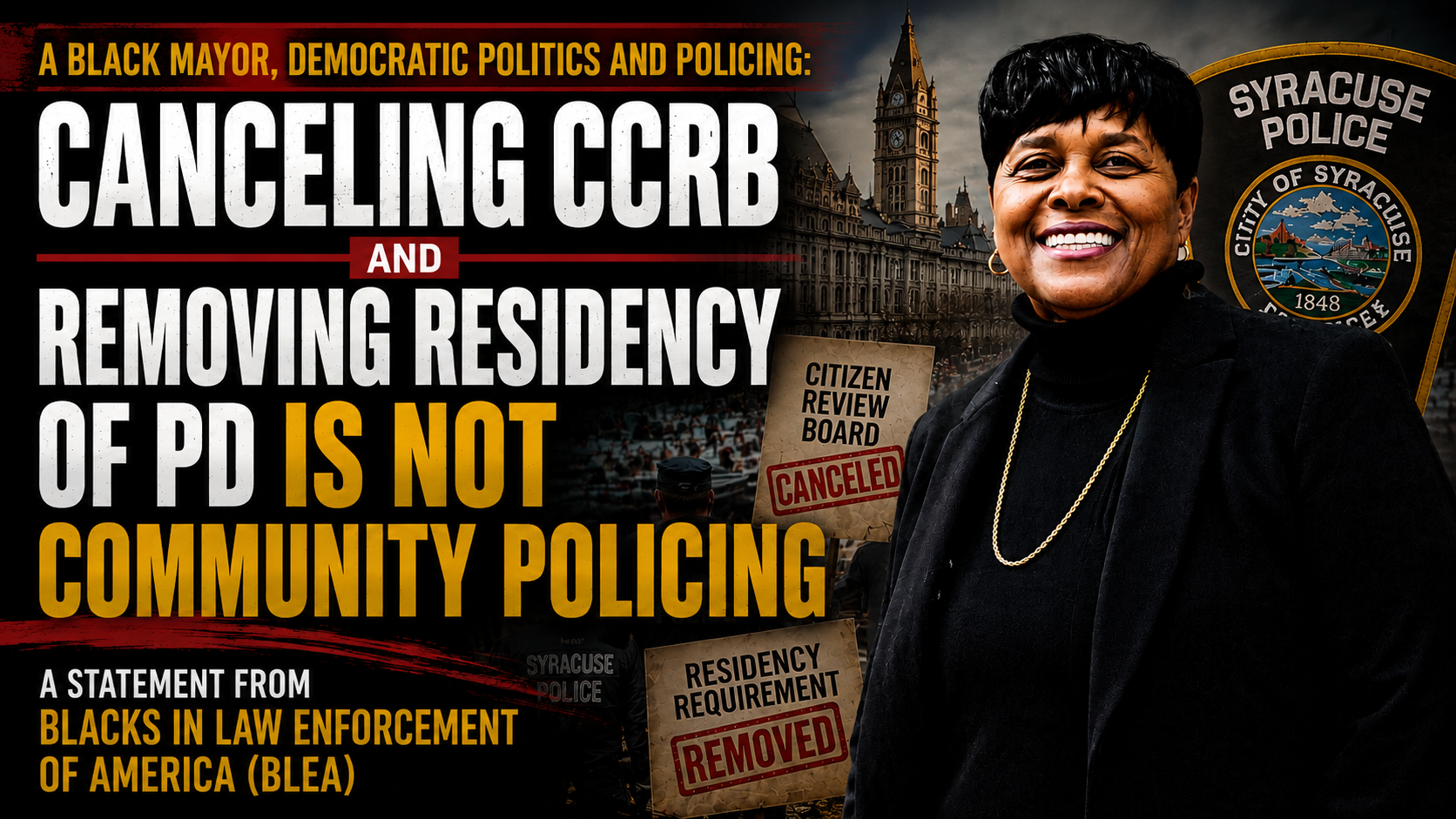
A Statement From Blacks In Law Enforcement of America — New York
The organization Blacks In Law Enforcement of America (BLEA) holds that police accountability, community policing, and public safety should never be decided based on political party. The principles which we require from Republican administrations should be the same as those which we demand from Democratic administrations, especially where policies have a direct impact on Black communities and on the relationship between law enforcement and the people whom the officers have promised to serve.
Which is why the recent events in Syracuse, New York, merit a serious examination. Sharon Owens became the city’s first Black mayor and was also only the second woman to have held the office. While her historic election should be acknowledged, representation does not in itself mean that there is accountability. Just as every other elected official, Black elected officials too must finally be judged on the policies they put into effect and on the impact those policies have upon the communities they represent.
It is particularly important because Syracuse has about 145,000 residents and a large Black population; hence, matters relating to police accountability, civilian complaints, officers’ residency, and relations with the community have direct effects on thousands of Black residents.
BLEA has for a long time held that effective community-oriented policing needs a number of closely related elements, among the most important of which are civilian involvement and oversight, a genuine connection between the police and the community, and accountability. Since no single measure can ensure good policing, weakening these measures can damage the trust that is necessary for law enforcement to function effectively.
The latest rulings in Syracuse bring into question two of these principles.
Syracuse Suspends Its Police Residency Requirement
The Owens administration negotiated an agreement with the Syracuse Police Benevolent Association for a pilot scheme which will temporarily suspend the city’s residency requirement for newly appointed police officers. In the past, new police officers in Syracuse had been required to set up residency in the city and to remain residents throughout their first five years of service.
Police Chief Mark Rusin has put forward a valid operational concern. Since the department is experiencing difficulties in recruiting officers and is also facing a number of retirements, Syracuse needs more officers and removing the requirement of residency as a condition of employment could increase the number of qualified applicants who apply to the department.
BLEA is aware of this difficulty; police departments all over the country have had problems with recruiting and keeping personnel, and insufficient staffing can in turn weaken community policing. If officers spend their whole shift dealing with one call after another, there will be fewer opportunities for proactive engagement, for building relationships with neighbours, and for solving problems.
Community connection cannot be separated from recruitment.
Residency involves more than just an officer’s mailing address. An officer who lives in the municipality that they police has the opportunity to become a homeowner, to pay taxes and to be a neighbour. Their children can go to the local schools, their families can make use of city services and they can shop at the same businesses, sharing many of the same quality-of-life issues as the residents they meet professionally.
Just because someone lives in a area doesn’t mean that they become a better police officer, and merely living outside a municipality doesn’t automatically make an officer bad. Yet residency can result in a deeper level of involvement on the part of officers in the communities they serve. The mayor herself has acknowledged this principle, stating that she believes it is in the best interests of Syracuse’s new officers, while also asserting that current recruitment circumstances make it necessary to temporarily suspend the requirement.
That raises an important question concerning public policy: Since residency is advantageous for community policing, what arrangement is Syracuse adopting to maintain the link between officers and residents?
National Policing Recommendations Recognized the Value of Residency
The issue in question isn’t merely one that stems from BLEA’s opinion; the President’s Task Force on 21st Century Policing, established during the Obama administration, had specifically addressed the importance of linking police officers to the communities they serve.
In the section titled Pillar One: Building Trust and Legitimacy, Action Item 1.5.2 suggested that law-enforcement agencies should establish residency incentive programs, such as Resident Officer Programs.
That point is important since the Obama Task Force did not advise that all police officers in each jurisdiction should be required to have a residence there. On the other hand, it did acknowledge that officer residency could act as a means of enhancing trust and legitimacy and suggested that departments set up incentives in order to encourage officers to live in the communities they police.
The Task Force’s wider recommendations concerning community policing also stressed the importance of regular contact between the officers and the neighbourhood residents, as well as with the faith and business leaders. Community policing was seen as going beyond just responding to calls for service; it was about the police and the residents working together to achieve public safety.
Syracuse had earlier taken this approach; in order to carry out its police reform, the city obtained the power to require new officers to live in Syracuse, and in 2021 the Common Council approved a deal which set the five-year residency requirement for new officers.
The fact that this has happened means that the present decision to drop the requirement deserves to be looked into. In the past Syracuse had regarded residency as an aspect of police reform and as a way of fostering community ties. The city is currently temporarily abandoning that requirement.
What became of Syracuse’s Citizen Review Board?
The second point concerns Syracuse’s Citizen Review Board (CRB): it was established to provide an independent civilian process for hearing, investigating, and reviewing allegations of police misconduct and recommending appropriate action.
There must be a clear distinction between civilian review and police management. The Citizen Review Board does not have the authority to direct the Syracuse Police Department, nor does it replace the police chief’s disciplinary authority. It gives residents an independent means, outside the police department, to look into allegations of misconduct.
In April 2026 the board’s independent investigations came to an end because Syracuse’s corporation counsel had decided that an appellate court decision concerning Rochester’s Police Accountability Board had meant that the Citizen Review Board in Syracuse could no longer legally carry out independent investigations. The Owens administration based its conclusion that independent CRB investigations could no longer go on on that legal interpretation.
BLEA is aware that government officials have a duty to comply with court decisions and with valid legal interpretations. Nevertheless, the actual effect of the administration’s stance was significant, in that a civilian organization set up to independently investigate allegations against police officers was prevented from carrying out its investigative role.
The Citizen Review Board and members of the Syracuse Common Council subsequently challenged that interpretation. CRB Chairman Donald Johnson argued that the mayor’s administration and corporation counsel could not unilaterally suspend responsibilities established through local legislation, and in August the board announced that it would resume investigating complaints.
In order to ensure accuracy, the Mayor Owens did not dissolve the Citizen Review Board; however, the administration’s legal stance led to the temporary suspension of one of the board’s most important functions.
Civilian Oversight Is Also a Nationally Recognized Principle
The Task Force on 21st Century Policing within the Obama administration also looked at the issue of civilian oversight, stating in Recommendation 2.8 that some kind of civilian oversight of law enforcement is important for strengthening trust within the community and noting that individual communities should decide on the appropriate structure.
This is important since residency and civilian review should not be regarded as minor or anti-police policies; rather, both have been acknowledged in national debates concerning the establishment of trust and legitimacy between law enforcement and communities.
Professional police officers should not be afraid of genuine accountability since misconduct which is not addressed harms the reputation of every officer who wears the badge with honor.
Likewise, civilian review should not be presented as equivalent to civilian control over policing. When properly organized, civilian review adds an extra degree of transparency and public confidence without affecting the legal authority of police leadership. Way from Two Important Principles
Each of the measures introduced by the Owens administration can explain both developments: the suspension of residency is intended to address recruitment and staffing. At the same time, the halt of CRB investigations resulted from the city’s understanding of an appellate court decision.
The distinctions are important, and BLEA holds that responsible criticism should recognize them.
Yet when these developments are considered as a whole, they raise a significant question—why is Syracuse, at the same time, moving away from two mechanisms linked to police-community trust?
The Obama Task Force suggested providing residency incentives and emphasized the importance of civilian oversight in building community trust. Previously, Syracuse had included residency as part of its police-reform initiatives. However, during the tenure of the city’s first Black Democratic mayor, the five-year residency requirement was temporarily suspended, and the administration also backed a legal interpretation that barred independent civilian investigations into police misconduct.
The question isn’t whether all the decisions taken by the Owens administration were wrong; it’s whether Syracuse will be able to show that the new arrangements in their place will achieve equal or greater degrees of community connection, transparency and accountability.
The Standard cannot change according to the political party.
There is also a bigger political problem which Black communities have to face. Suppose that these same policies were put into effect under a Republican administration in a city having a large Black population—would Black political groups and Democratic elected officials accept such developments without examining them?
We must not alter our standards according to the political party, race, or gender of the mayor.
It cannot be considered a principle of the Democrats for police accountability to exist when the Republicans are in control and yet become negotiable when the Democrats take over government. In the same way, the fact that Black people have political representation does not mean that Black elected officials are subject to less scrutiny when carrying out policies that affect Black communities.
Sharon Owens’s election as Syracuse’s mayor, making her the city’s first Black mayor, is of great significance. BLEA also acknowledges the historical importance of this achievement. However, accountability must exist alongside history and representation, not take its place.
Public Safety and Accountability Must Work Together
America’s Black presence in law enforcement is well positioned to grasp this issue from a perspective that is occasionally absent from the wider national discussion. Since our members have donned the uniform, worked within law-enforcement organizations, and faced the dangers and responsibilities of protecting communities, they understand the situations officers actually encounter. Moreover, they understand the historical relationship between law enforcement and Black Americans and therefore see why transparency, community trust, and real accountability remain essential.
The belief that supporting police officers and calling for police accountability are opposed positions is wrong. Professional policing demands both of these things. Communities have a right to qualified officers, sufficient staffing, and effective public safety. In contrast, officers themselves are entitled to have leadership and systems in place which preserve professional standards and public confidence.
BLEA therefore thinks that Syracuse should make it clear how stopping the requirement of residency will have the effect of strengthening rather than weakening community policing, what criteria will be used to judge whether the pilot is a success, and what policies will encourage officers who live outside Syracuse to form close and meaningful relationships with the residents they police. The city must also ensure that residents continue to have a reliable and independent means of addressing allegations of police misconduct in a manner consistent with applicable law.
They shouldn’t be questions for Republicans or Democrats; they should be regarded as questions concerning professional policing, public safety, and community trust.
The policy on Black people in law enforcement in America will stay the same no matter who is in charge at City Hall. We back good police officers. We back professional policing. We back genuine community engagement. And we back accountability.
The badge must not be defended on political grounds, and accountability must not be based on one’s political party. If an elected official is Black or white, a Democrat or a Republican, our duty is to support policies that safeguard the integrity of the law-enforcement profession while keeping the voices and trust of the communities we have promised to serve.
