

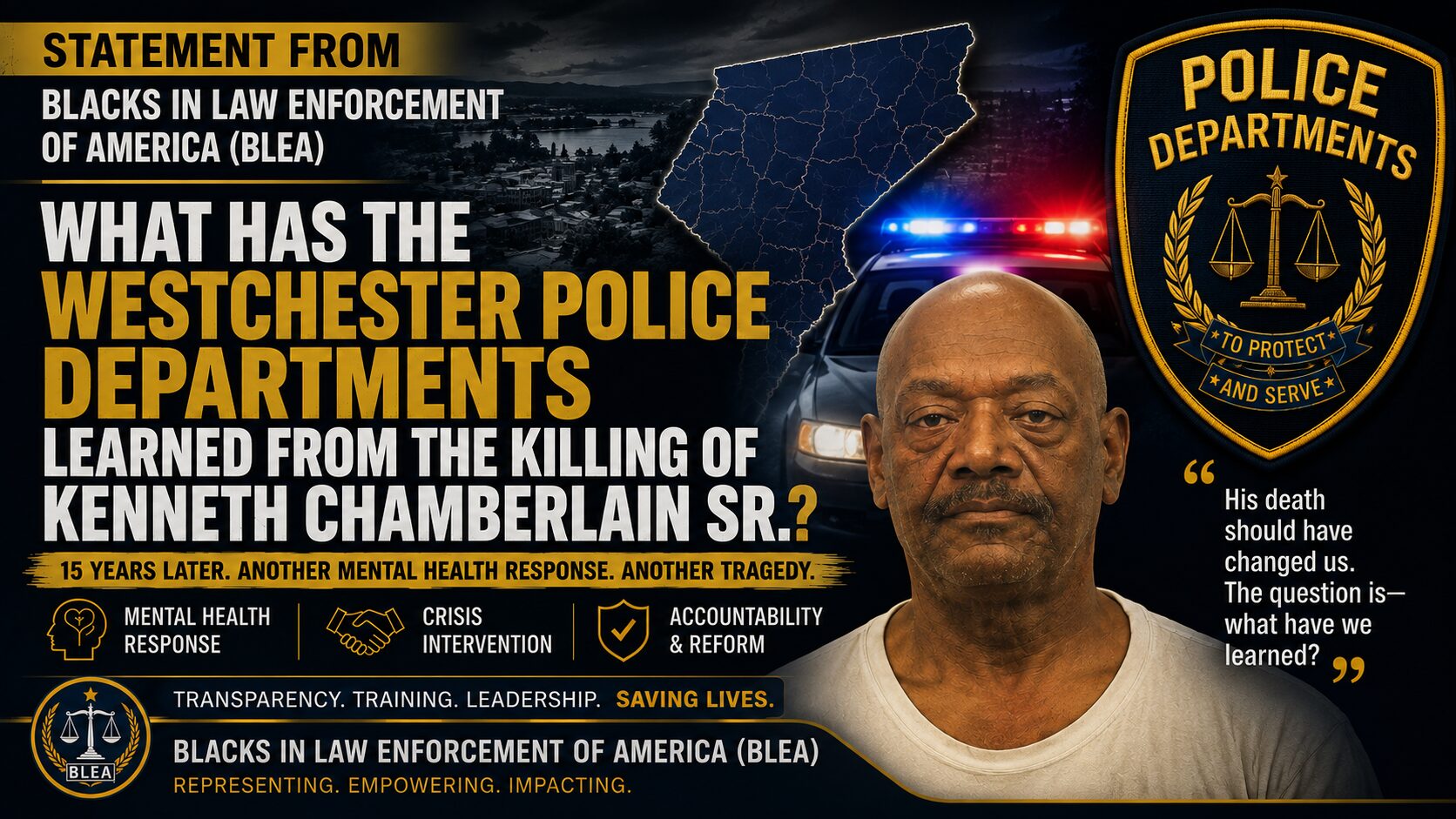
Blacks in Law Enforcement of America (BLEA) is deeply concerned by the recent officer-involved shooting that occurred during a court-ordered mental health response in the City of Mount Vernon.
According to the Mount Vernon Police Department and the New York State Police, officers responded to execute a court-authorized mental health commitment order for a 58-year-old man who was reportedly armed with two knives. Officers negotiated with him for approximately four hours before obtaining warrants, breaching the apartment door, deploying less-lethal measures—including Tasers and beanbag rounds—and ultimately discharging a firearm. The New York State Police are conducting the investigation, which remains ongoing.
BLEA supports a thorough, independent investigation and believes every officer involved is entitled to due process. The facts—not speculation—must determine whether the use of force was legally justified.
However, regardless of the legal outcome of this investigation, this incident raises broader public policy questions that deserve careful examination.
Fifteen years after the death of Kenneth Chamberlain Sr., the law enforcement profession must ask itself one important question:
What have Westchester County police departments learned from the killing of Kenneth Chamberlain Sr.?
Kenneth Chamberlain Sr.’s death became a national catalyst for discussions about crisis intervention, de-escalation, and specialized responses to individuals experiencing mental health crises. Police agencies pledged to improve training, strengthen crisis response protocols, and reduce the likelihood that mental health interventions would end in tragedy.
Yet today, another mental health response in Westchester County has ended with police gunfire.
According to the publicly released information, officers spent hours attempting to resolve a court-ordered mental health intervention. Crisis negotiators were present. The department’s Wellness Division responded. Less-lethal options were reportedly deployed. Despite those resources and planning, the incident still ended with deadly force.
If you review the publicly available investigative reports surrounding the Kenneth Chamberlain incident, there are broad similarities that have been publicly discussed: forced entry into a residence, the use of less-lethal options such as Tasers and impact munitions, followed by deadly force. While every incident must be judged on its own facts, those similarities raise legitimate questions about whether law enforcement’s overall response to mental health crises has fundamentally evolved.
This incident also raises another troubling question.
Over the past fifteen years, Westchester County has witnessed multiple officer-involved shootings involving individuals reportedly experiencing mental health crises, including the killing of Kenneth Chamberlain Sr. and the 2014 shooting of Anthony Smith in Mount Vernon. Now, another court-ordered mental health intervention has ended with police gunfire.
Whether there have been four, five, or more such incidents, the larger issue remains the same. These cannot simply be viewed as isolated events. Every one of these encounters should have informed better training, stronger crisis intervention, improved de-escalation tactics, and more effective leadership.
The question is not only whether each individual use of force was legally justified.
The question is whether Westchester County law enforcement has learned from each of these incidents and translated those lessons into measurable improvements that reduce the likelihood of another person experiencing a mental health crisis being shot.
BLEA believes the public deserves answers to important questions:
- What measurable changes have police departments implemented since the death of Kenneth Chamberlain Sr.?
- Are crisis intervention and de-escalation programs producing better outcomes?
- Do Wellness Division personnel and mental health professionals have meaningful operational authority during these incidents?
- Are officers receiving nationally recognized Crisis Intervention Team (CIT) or equivalent training that is regularly updated and evaluated?
- Are agencies measuring success by reducing the need for deadly force whenever it is reasonably possible to do so?
The Need for Countywide Leadership
BLEA is equally concerned by the apparent silence of the Westchester County Chiefs of Police Association regarding what lessons have been learned from the killing of Kenneth Chamberlain Sr. and how those lessons have been incorporated into countywide policy, training, and leadership.
If Kenneth Chamberlain’s death truly transformed policing in Westchester County, then the public deserves to know:
- What countywide changes have been implemented since his death?
- Has the Chiefs Association developed model policies for responding to mental health crises?
- Has it recommended standardized Crisis Intervention Team (CIT) training for every police department in Westchester County?
- Has it evaluated whether those reforms are producing measurable improvements?
- What role has it played in helping ensure another Kenneth Chamberlain tragedy does not occur?
These are not questions meant to criticize the profession.
They are questions that professional law enforcement leadership should be prepared to answer.
Leadership requires more than issuing statements after tragedies. It requires demonstrating that lessons have been learned and that those lessons have resulted in better outcomes.
A Question Every Law Enforcement Leader Should Answer
With today’s technology, specialized crisis intervention teams, advanced less-lethal equipment, body-worn cameras, shields, and years of enhanced training, the public has a right to ask a difficult question:
In 2026, are we really saying that law enforcement is incapable of safely taking a mentally ill person armed with a knife into custody without resorting to deadly force?
BLEA recognizes that officers often confront dangerous, rapidly evolving situations where deadly force may be legally justified and necessary to protect themselves or others.
However, when an incident involves hours of negotiations, a court-ordered mental health intervention, crisis negotiators, a Wellness Division, and less-lethal options, it is appropriate to ask whether different tactics, supervision, leadership, or crisis intervention strategies could have produced a different outcome.
As someone who served 33 years as a correction officer, I know firsthand that correction officers routinely confront inmates armed with homemade knives and other dangerous weapons. Through coordinated team tactics, communication, protective equipment, shields, and controlled extraction procedures, many of these incidents are resolved without deadly force.
Policing and corrections are different professions with different legal standards, environments, and operational realities. Nevertheless, both professions share the same responsibility whenever possible:
Protect life.
That is why every critical incident should be examined for lessons that can improve future responses.
These are not anti-police questions.
They are professional accountability questions.
The recent findings by the U.S. Department of Justice regarding the Mount Vernon Police Department make these questions even more significant. Public confidence is not restored through press releases alone. It is restored through measurable improvements in training, leadership, supervision, accountability, and outcomes.
BLEA supports preserving all evidence, conducting a thorough independent investigation, and releasing body-worn camera footage when legally permissible. Transparency protects officers when their actions are justified and promotes accountability when improvements are necessary.
Conclusion
Kenneth Chamberlain Sr. should not be remembered only as a tragedy.
His death should have transformed how every police department in Westchester County responds to people experiencing mental health crises.
Fifteen years later, another mental health response has ended with gunfire.
The question before the people of Westchester County is no longer whether reform was promised.
The question is whether reform has been achieved.
If police departments have changed their policies, improved their training, strengthened crisis intervention, and invested in wellness and de-escalation, then those efforts should be reflected in measurable outcomes—not repeated tragedies.
BLEA calls upon every police chief, sheriff, commissioner, the Westchester County Chiefs of Police Association, county officials, and municipal leaders to publicly explain what has changed since the killing of Kenneth Chamberlain Sr., how those changes are being measured, and whether they are producing safer outcomes for both officers and the communities they serve.
The public deserves more than promises.
The public deserves measurable results.
Damon K. Jones
New York State Representative
Blacks in Law Enforcement of America (BLEA)
